
Mid Suffolk
Set among small villages, market towns and isolated farmsteads, Mid Suffolk was a landscape shaped by close-knit communities, strong religious feeling and long-standing local tensions.
MID-SUFFOLK
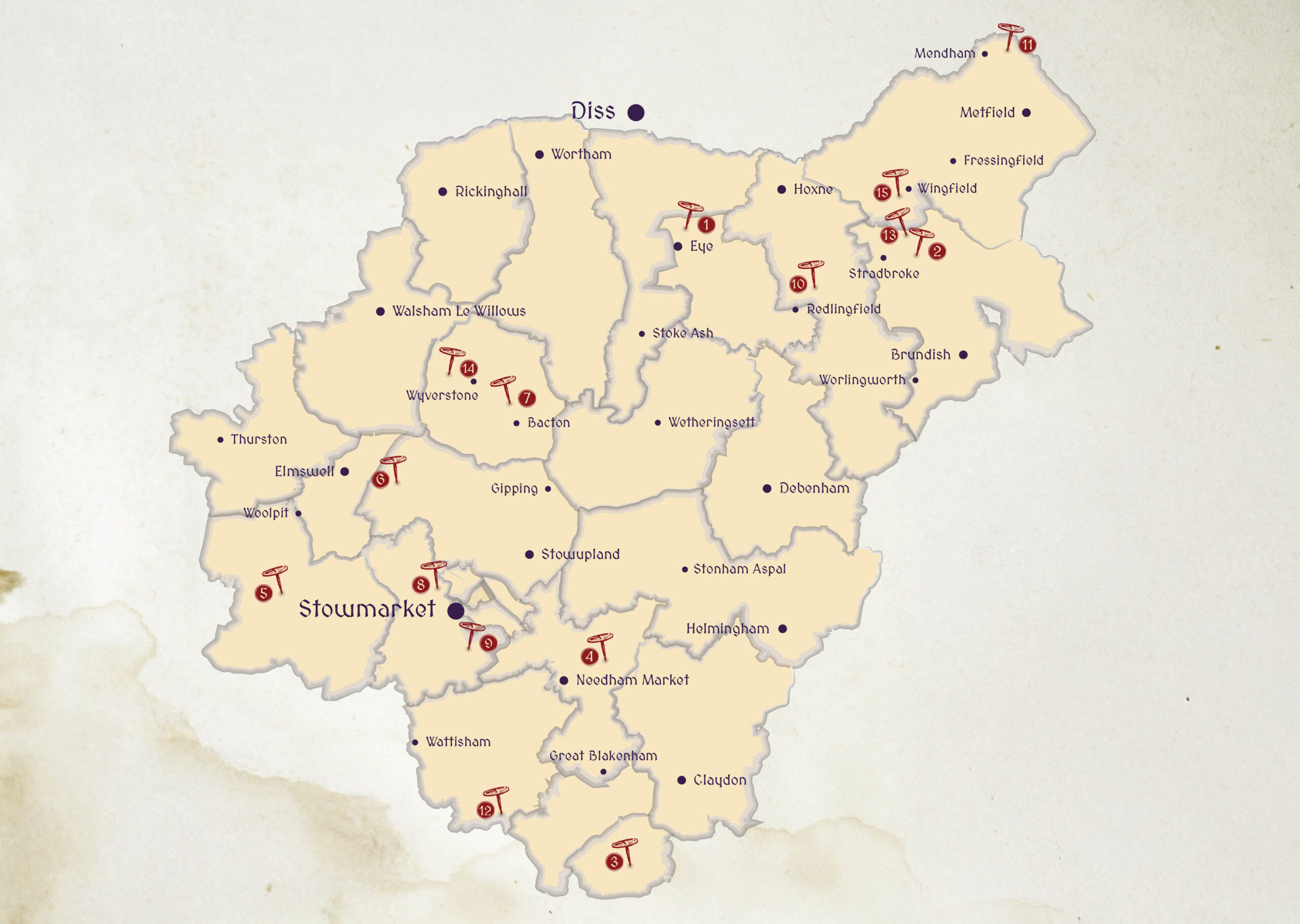
1. Eye: (1441) Margery Jourdemaine (The Witch of Eye)
2. Stradbroke: (1599) Oliffe Barthram
3. Bramford: Alice Marsh, Elizabeth Richmond, Payne (male), Alice Wright, Anne Cricke
4. Creeting St Mary: Anne Hammer, Nicholas Hempstead
5. Rattlesden: Old Mother Orvis, Elizabeth Deekes (and mother), John Scarfe, Meribel Bedford, Henry Carre
6. Wetherden: Elizabeth Fillet (Tillett), Grace Gunburgh
7. Bacton: Margaret Bennett, Mary Bush, Elizabeth Watcham, Ellen Greenliefe
8. Stowmarket: Elizabeth Hubbard, Goodwife Low, Goodwife Mills
9. Combs: Mary Fuller
10. Horham: Names unknown
11. Mendham: Margery Sparam (Sparham)
12. Offton: Margery Tray
13. Stradbroke: Anne Arnoll, Bet Bray, Anne Wright, Elizabeth Greene
14. Westhorpe: Susanna Dexe
15. Wingfield: Elizabeth Greene
BRAMFORD
Five women were accused in Bramford; Alice Marsh, Elizabeth Richmond, Payne (male), Alice Wright, Anne Cricke.
Anne Cricke
Anne Cricke (also of Hitcham) confessed to sending a familiar to bewitch a pig belonging to a farmer who had denied her eggs.
Alice Wright
Alice Wright (of Hitcham) admitted to having imps that nipped and sucked at her.
Payne (male)
A man named Payne was interrogated by John Stearne over eight days before finally admitting that the Devil had come to him while he was ploughing, and that he had given up his soul.
Elizabeth Richmond
Elizabeth Richmond admitted to worshipping a figure she called ‘Daniel the Prophet’, rejecting both God and the Church.
Alice Marsh
Alice Marsh confessed that she had offered her body to the Devil – though not her soul – and had signed a contract with him in her own blood.
CREETING ST MARY
Nicholas Hempstead
Nicholas Hempstead was pressed by Stearne until he confessed to sending his own imps to kill a horse and to attack men in his regiment. Both were named as witches. Stearne claimed that Hempstead had used witchcraft to destroy horses intended for the parliamentary army...
Anne Hammer
Anne Hammer of Creeting St Mary confessed to Stearne that she had been visited by two imps, which she later sent to kill a child belonging to one Master Campe. She also admitted to having 'lain with the Devil'.
RATTLESDEN
Stearne passed through Rattlesden, Wetherden and Bacton on his way north-east. In Rattlesden, he gathered evidence against a number of suspects.
Meribel Bedford
Meribel Bedford was also named among the Rattlesden accused.
Henry Carre
Henry Carre was also named among the Rattlesden accused.
John Scarfe
John Scarfe, related to two other Rattlesden accused Mother Orvis and Elizabeth Deekes and known locally as ‘a heathenish man’, admitted to keeping three grey rats – Tom, Will and Harry – and feeding them from his body.
Elizabeth Deekes
Elizabeth Deekes – whose mother had also been executed as a witch – confessed that she had been instructed to renounce God and had made a pact with the Devil. “First, ignorant people whose eyes are blinded by Satan and are led captive by him, as is said in another...
Unnamed boy
On his return journey to Lawshall, Stearne revisited Rattlesden, where suspicion had settled on a boy of about eight or nine (name unknown), who had previously been questioned at Rougham near Bury. He had reportedly accepted the service of an imp, not understanding...
Mother Orvis
A woman known as Old Mother Orvis, a local matriarch, was accused by a woman named Bedford who claimed that Orvis had sent her a spirit called Meribell, who promised power and prosperity and then left her with four imps.
Wetherden
Grace Gunburgh
Grace Gunburgh and Elizabeth Fillet (Tillet), were watched and searched by John Waller and James May who testified to what they had seen when they had kept watch over Gunburgh. Both women were committed for trial
Elizabeth Fillet (Tillet)
The Manor at Haughley Park was home to the Sulyard family. Amongst their staff was Elizabeth Fillet (Tillet) who was accused by a local man John Spinke, a cobbler, and his wife, of causing his child to suffer from spasms and an infestation of lice. Spinke testified...
Bacton
Bacton was a community gripped by social and spiritual unrest. A group of women were accused of trading their souls to upend the village’s power dynamics and tensions between rich and poor had been sharpened by the implementation of the Poor Law.
The main accusers included Henry Prettyman (Lord of the Manor), John Marleton (Puritan rector of St Mary’s), yeoman farmers Garnham and Lockwood, and Widow Hoggard, a cattle farmer.
Also implicated in Bacton was Elizabeth Watcham, a middle-aged woman.
On a Monday evening, all four women – Bennett, Bush, Watcham and Greenliefe – were arrested. The rector, John Marleton, heard the confessions of Bennett and Bush. Greenliefe also admitted to laming Goodman Garnham’s cow and sending a swarm of lice to Master Lockwood.
Records from Chelmsford Gaol list a Mary Greenliefe who dies of bubonic plague whilst awaiting trial. It is believed that Mary and Ellen were the same person.
Elizabeth Watcham
Elizabeth Watcham (recorded as middle-aged)
Margaret Bennett
Margaret Bennett (who came from just outside Bacton) was implicated by Henry Prettyman (Lord of the Manor), John Marleton Puritan Rector of St Mary’s, Garnham (Yeoman farmer), Lockwood (also a farmer) and Widow Hoggard (cattle farmer).
Ellen Greenliefe (née Barnard)
Also implicated in Bacton was Ellen Greenliefe (née Barnard), who appeared before Stearne in her mid-forties. After Ralph Hoggard threatened to have her searched for the Devil’s mark, his horse went lame.
Mary Bush
Mary Bush, a widow of 18 years, left childless and penniless. Forced to beg door-to-door to supplement her poor relief after her payments were cut off by Lord of the Manor, Henry Prettyman and Goddard, two of the accusers in Bacton. They later claimed to be terrified...
Stowmarket
Stowmarket, one of Suffolk’s largest towns and a model of the Reformation, saw several witchcraft accusations during the 1640s. John Stearne himself testified at the assizes against two men of the town accused of witchcraft, but the grand jury rejected the charges.
Goody Low and Goody Mills
Goody Low and Goody Mills were also named as witches in now-lost parish accounts.
Elizabeth Hubbard
Elizabeth Hubbard (also referred to as Hobert), a widow, confessed to maleficium involving her family and she claimed to have three imps who appeared to her as children. The accusers of Elizabeth Hobert included William Manning, John Hayward, Richard Foreman, William...
Combs
Combs was a parish with a tradition of puritan dissent. Its minister between 1615 and 1647 was the godly Thomas Sothebie, who married the daughter of Edmund Dandy, lord of the manor of Combs. This small village also supplied migrants to New England in 1630. In 1647, a returning émigré, Richard Jennings (1616-1709), became rector of the parish until his ejection in 1662, like his predecessor he married another daughter of the Lord of the Manor.
Only the name Mary Fuller remains from these trials.
Horham
In January 1646, the magistrates at Ipswich ordered the people of Athelington, Horham and Brandeston to appear before them to ‘hear and determine their differences as to payment of rates towards charges of Witches 78 accused by the town of Branston’. Constables or churchwardens who refused to set a rate, or parishioners who refused to pay, were to be bound over.
The names of the Horham victims are unknown
Mendham
Margary Sparham
Margary Sparham confessed to using her imps to protect her husband, a soldier, and that she was also encouraged by the Devil to kill Mrs Jacob, who did die, ‘but not so soone as she expected’. On the testimony of Jacob Neech, she was described as ‘a lewd woman’ who...
Stradbroke
More than forty years before the Hopkins trials, Stradbroke had already experienced a witch hunt with strong Puritan influences. In 1599, a local woman was executed at Bury St Edmunds, and her case was later used by supporters of the Puritan exorcist John Darrell.
By the 1630s, Stradbroke was deeply divided by religious conflict.
Mother (Anne) Arnoll
Anne and Mary Smith (of Glemham) claimed that they had sold one imp to Mother (Anne) Arnoll of Stradbroke.
Bet Bray
Anne and Mary Smith (of Glemham) claimed that they had sold one imp to Bet Bray.
Goody Wright (Anne Wright)
Elizabeth Greene of Wingfield confessed that one Goody Wright of Stradbroke had sent her three imps. Greene’s confederate was probably Anne Wright, separately named as a witch elsewhere in the same depositions.
Westhorpe
In the years leading up to the witch hunts, Westhorpe was a deeply divided parish shaped by intense religious conflict. From 1630 to 1636 it was dominated by the strict Puritan minister Robert Stansby, whose refusal to follow Church of England practices led to his removal. His departure caused many committed Puritans to leave the village, including families who later emigrated to New England and became involved with radical religious movements there. Those who stayed behind remained sharply divided, and resentment continued under his replacement, Samuel Scrivener, who was later removed himself during the Civil War. This long period of mistrust, moral judgement and ideological conflict created an atmosphere in which accusations, suspicion and the policing of behaviour became normal – conditions that helped pave the way for the witch accusations that would soon follow in neighbouring communities.
Susanna Dexe
Susanna Dexe admitted, under examination after being watched, that she was responsible for the illness of Thomas Mills of Westhorpe. She subsequently repeated her confession before the justices.
Wingfield
Little is known about Wingfield’s religious life before the witch hunts, but in the years that followed it became a centre for radical religious ideas.
Elizabeth Greene
Elizabeth Greene of Wingfield confessed that Goody Wright of Stradbroke had sent her three imps. Greene’s confederate was probably Anne Wright, separately named as a witch elsewhere in the same depositions.